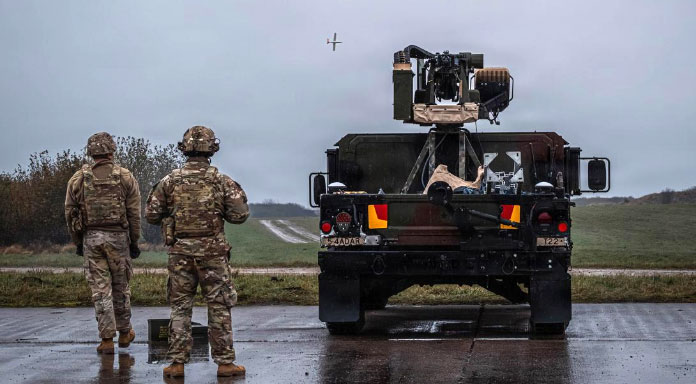
U.S. Army air defenders with 5th Battalion, 4th Air Defense Artillery Regiment, engage with a fixed-wing aerial drone target with a counter-unmanned aircraft system during Project Flytrap 4.5 in November 2025, at the Truppenubungsplatz Putlos, Germany. U.S. Army photo by Staff Sgt. Yesenia Cadavid
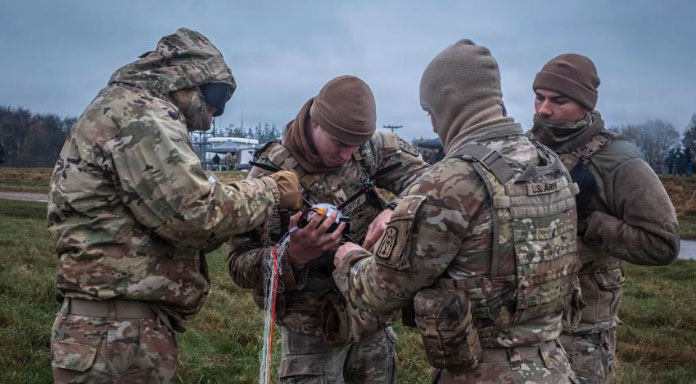
U.S. Army air defenders with 5th Battalion, 4th Air Defense Artillery Regiment, inspect drone captured by a counter-unmanned aircraft system drone interceptor during Project Flytrap 4.5 in November 2025, at the Truppenubungsplatz Putlos, Germany. U.S. Army photo by Staff Sgt. Yesenia Cadavid

U.S. Army photo shows a counter-unmanned aircraft system drone interceptor capturing a drone during Project Flytrap 4.5 in November 2025, at the Truppenubungsplatz Putlos, Germany. U.S. Army photo by Staff Sgt. Yesenia Cadavid
This month, Army officials in Europe are striving to propel the counter-unmanned aircraft systems (C-UAS) space forward by hosting Project Flytrap 5.0. At the event, soldiers will prioritize counter-drone systems and experiment with and demonstrate a handful of C-UAS-based capabilities to identify successful options that they can use to bolster their arsenal.
Through observations and lessons learned from the war between Russia and Ukraine, U.S. Army personnel are discovering the vital role that effective UAS tools play in winning the fight on the present-day battlefield. But just how instrumental are these capabilities? In fact, the utilization of these advanced technologies signifies a “fundamental transformation” in the execution of operational warfare, according to Maj. Mark Sauser of the U.S. Army.
Furthermore, integrating UAS into military operations has compelled opposing forces to adjust their command-and-control tactics, techniques and procedures, especially regarding their planning strategies and attack and defensive methods, and to stress the significance of, and become more effective and efficient at, infusing data and intelligence into operations. This exponentially elevated impact of UAS-based tools on the revolutionized battlefield reveals the direct relationship between UAS and C-UAS. In other words, as the UAS space becomes more important, so does the C-UAS space—exactly what Project Flytrap 5.0 contributors are working to address. For example, U.S. military officials are learning that Russian and Ukrainian forces are using UASs to monitor and investigate each other, which is limiting their ability to launch unexpected attacks on one another, per Sauser. To remedy this issue, the opposition must develop and integrate C-UASs to attack and eliminate the surveillance UASs.
Not only are U.S. defense personnel learning about emerging tactics, techniques and procedures that have been on display during the Russia-Ukraine War and unlocked by the creation of innovative technologies, but they are also discovering and identifying specific capabilities with high potential that they seek to interact with at Project Flytrap 5.0.
“One of the things that we look at when we look at the vendors and the capabilities that are coming out [to Project Flytrap] is: Is it being tested in Ukraine and is it being used in Ukraine?” Capt. Gabriel Glazer, squadron signal officer in the Field Artillery Squadron, 2nd Cavalry Regiment, said during an interview with SIGNAL Media. “We’re seeing the war in the east as a learning lab for the Army to drive its transformation. So, we’re really excited about a couple of vendors that are using those systems in Ukraine and giving them to Ukrainians to defend themselves.”
Project Flytrap 5.0 crews plan to test over 60 systems in harsh and contested environments to see which ones can remain effective despite the circumstances. Of the 60 capabilities, leaders are especially interested in observing firsthand the potential of several C-UAS-based tools developed by Moodro, Allen Control Systems and Areté.
Soldiers will assess Moodro’s Varta and Spectrofy systems during the event. The Varta system is a dismounted radio-frequency detection system that also gives users the ability to access and view the video feed from first-person-view drones controlled by adversaries, according to Capt. Cameron Woodard, squadron intelligence officer in the 3rd Squadron, 2nd Cavalry Regiment. This C-UAS-based capability enables soldiers to see exactly what the drones are watching.
“I’m very excited to see that get tested, because a lot of times when a first-person view [drone] is flying over top of you, and you’re undercover, you can’t tell if it’s actually observing you or not, which leads into the questions of have I been observed? Do I need to move?” Woodard said. “So, if I have the video feed from the first-person view drone, I can say, ‘Yes, I’ve been observed, and I need to move before indirect fire gets called up here or something like that.’” The Spectrofy device can allow users to view a drone’s pinpointed location and movement direction, according to Moodro personnel. This tool provides soldiers with knowledge of the opposition’s movements and when enemies are possibly watching their operations, subsequently limiting adversaries’ ability to stealthily maneuver via UAS.
Warfighters will also examine Allen Control Systems’ Bullfrog M2 system paired with Areté’s electro-optical/infrared (EO/IR) camera capabilities. The Bullfrog M2 is an automatic, semi-artificial intelligence (AI)-based ballistic weapon system that, with help from Areté’s EO/IR cameras, can uncover, locate, address and eliminate unmanned systems, per Allen Control Systems personnel. More specifically, when dealing with a type 1 UAS, the EO/IR camera from Areté can detect the unmanned system, and then it can send the digital longitude and latitude data directly to the Bullfrog M2 system. Soldiers at the platoon or troop levels can then assign that task and use the Bullfrog M2 capability to neutralize the UAS, per Capt. Brendan Printup, commander of the Eagle Troop, 2nd Squadron, 2nd Calvary Regiment. Printup added that during a simulation conducted in a controlled environment, the entire process took about 25 seconds. This combination of capabilities has only been put through initial simulated and controlled testing, so the experiments and assessments taking place at Project Flytrap 5.0 will be a major step in the inspection process for the possible partnership between Bullfrog M2 and Areté’s EO/IR cameras.
